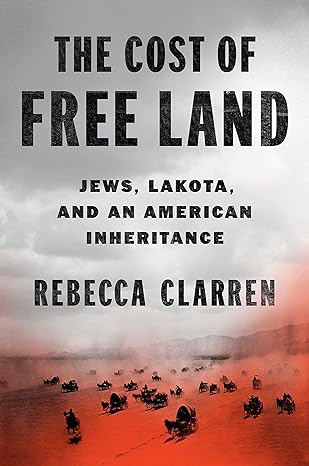
The Cost of Free Land: Jews, Lakota, and an American Inheritance by Rebecca Clarren
The Cost of Free Land: Jews, Lakota, and an American Inheritance by Rebecca Clarren
Excellent 4.9
19,544 Reviews
Trustpilot


465 sold in the past 24 hours
401 people are viewing this item
Only 1% left in stock
Regular price
$23.36
Regular price
$23.36
Sale price
$32.00
Unit price
per
Couldn't load pickup availability

The Cost of Free Land: Jews, Lakota, and an American Inheritance by Rebecca Clarren
Regular price
$23.36
Regular price
$23.36
Sale price
$32.00
Unit price
per
🔒 Order with Confidence
🔒 Order with Confidence
✅30-Day Money Back Guarantee — no risk trying it.
🚚Free shipping available. Orders processed within 24–48 hours.
🔐Secure & encrypted checkout with trusted payment providers.
An award-winning author investigates the entangled history of her Jewish ancestors' land in South Dakota and the Lakota, who were forced off that land by the United States government
"A brilliantly conceived family history, one that places questions of responsibility and atonement at the center of the conversation about America's political future."—the Whiting Foundation
Growing up, Rebecca Clarren only knew the major plot points of her tenacious immigrant family’s origins. Her great-great-grandparents, the Sinykins, and their six children fled antisemitism in Russia and arrived in the United States at the turn of the 20th century, ultimately settling on a 160-acre homestead in South Dakota. Over the next few decades, despite tough years on a merciless prairie and multiple setbacks, the Sinykins became an American immigrant success story.
What none of Clarren’s ancestors ever mentioned was that their land, the foundation for much of their wealth, had been cruelly taken from the Lakota by the United States government. By the time the Sinykins moved to South Dakota, America had broken hundreds of treaties with hundreds of Indigenous nations across the continent, and the land that had once been reserved for the seven bands of the Lakota had been diminished, splintered, and handed for free, or practically free, to white settlers. In The Cost of Free Land, Clarren melds investigative reporting with personal family history to reveal the intertwined stories of her family and the Lakota, and the devastating cycle of loss of Indigenous land, culture, and resources that continues today.
With deep empathy and clarity of purpose, Clarren grapples with the personal and national consequences of this legacy of violence and dispossession. What does it mean to survive oppression only to perpetuate and benefit from the oppression of others? By shining a light on the people and families tangled up in this country’s difficult history, The Cost of Free Land invites readers to consider their own culpability and what, now, can be done.
View full details
"A brilliantly conceived family history, one that places questions of responsibility and atonement at the center of the conversation about America's political future."—the Whiting Foundation
Growing up, Rebecca Clarren only knew the major plot points of her tenacious immigrant family’s origins. Her great-great-grandparents, the Sinykins, and their six children fled antisemitism in Russia and arrived in the United States at the turn of the 20th century, ultimately settling on a 160-acre homestead in South Dakota. Over the next few decades, despite tough years on a merciless prairie and multiple setbacks, the Sinykins became an American immigrant success story.
What none of Clarren’s ancestors ever mentioned was that their land, the foundation for much of their wealth, had been cruelly taken from the Lakota by the United States government. By the time the Sinykins moved to South Dakota, America had broken hundreds of treaties with hundreds of Indigenous nations across the continent, and the land that had once been reserved for the seven bands of the Lakota had been diminished, splintered, and handed for free, or practically free, to white settlers. In The Cost of Free Land, Clarren melds investigative reporting with personal family history to reveal the intertwined stories of her family and the Lakota, and the devastating cycle of loss of Indigenous land, culture, and resources that continues today.
With deep empathy and clarity of purpose, Clarren grapples with the personal and national consequences of this legacy of violence and dispossession. What does it mean to survive oppression only to perpetuate and benefit from the oppression of others? By shining a light on the people and families tangled up in this country’s difficult history, The Cost of Free Land invites readers to consider their own culpability and what, now, can be done.